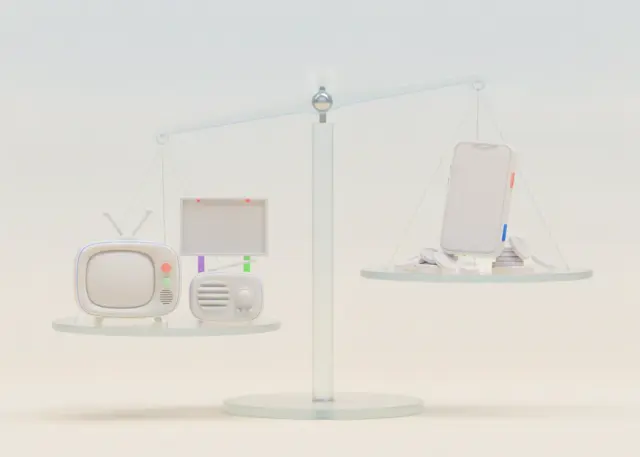
Attention moved, but not evenly
Ten years ago, a local TV buy reached most households in a market. That is no longer true. Nielsen's monthly Gauge reports have shown streaming growing into a leading share of US television viewing time, ahead of cable or broadcast alone.
Audio followed a similar path. Podcasts and streaming music now take a meaningful slice of commute time, especially among younger adults. Print readership has narrowed to older, loyal audiences.
Search changed too. People still type or speak a question when they need a lawyer. But Google now answers many queries with AI Overviews, so the click path is shorter and less predictable.
The shift is uneven by age, income and region. A firm serving retirees in a mid-size market sees a different audience mix than a firm courting gig workers in a large metro. Look at who your clients are before you look at national trends.
The line between TV and digital is blurring
Connected TV (CTV) is the clearest example. An ad on a streaming app plays on the same living room screen as a broadcast spot. But it is bought digitally, often by household, zip code or audience segment, and reported by impression.
The same is true for streaming audio, podcast ads and digital billboards. Each borrows the format of traditional media and the buying model of digital. For a law firm, that means the old question, TV or internet, is the wrong frame. The better question is which audience, in which moment, at which price.
What did not change is the creative job. A 30-second spot still needs one message, one phone number and one reason to remember your name.
Measuring TV, radio and billboards
Broadcast is often called unmeasurable. That is too generous to the skeptics. It is harder to measure, not impossible.
- Unique phone numbers. Give each station, board or flight its own tracking number. A memorable vanity number helps recall.
- Call lift. Log the exact air time of every spot. Compare calls in the following hour with a baseline.
- Branded search. Many viewers do not call. They search your firm's name later. Watch branded search volume and direct traffic during flights.
- Intake question. Ask every caller how they heard about you, and record it in a fixed list, not free text.
- Matched markets. If you serve several cities, run broadcast in one and hold another back. The difference in signed cases is the clearest read you will get.
Measuring digital, and its blind spots
Digital looks precise because every click is logged. That precision can mislead.
Ad platforms report conversions they helped cause, and some they did not. Last-click reports credit search for clients who first saw your billboard. View-through numbers credit display ads that someone scrolled past. Zero-click results in AI Overviews mean some people learn about you without ever visiting.
Close the loop with your own data. Import signed cases from your case management system back into Google Ads as offline conversions. Track calls, not just forms, because many legal clients phone first. Then judge every channel, digital or not, by the same yardstick. Our breakdown of what each channel really costs shows how to calculate cost per signed case.
When traditional still makes sense
Broadcast is not a relic. In some situations it is the most efficient tool a firm has.
Mass torts
Potential claimants for a drug or product injury often do not know they have a case. They will not search for it. Daytime TV and radio can reach large, older audiences who match the exposure profile, and that awareness is what starts the search.
Personal injury in large markets
After a crash, many people call the name they already know. Firms that have run broadcast for years build that recall. In dense metros, high search costs can make brand recall the cheaper path to the phone ringing.
Audiences digital underserves
Spanish-language radio, local news viewers and older homeowners may respond better to broadcast than to social ads. Billboards on commuter routes can still work where the same faces pass every day.
Moments when people are not online
Some needs surface away from screens: a long drive, a waiting room, a game on the bar TV. Radio, outdoor and in-venue screens reach people in those moments. The ad will not convert on the spot, but it can be the name they remember when they finally search.
Broadcast makes less sense for niche practices, small budgets or firms without intake staff ready for call spikes.
A blended plan in three layers
Most firms get the best results by stacking channels on purpose rather than picking a side.
- Foundation. A fast, credible website, a complete Google Business Profile and steady reviews. Every other channel sends people here. Start with law firm website design and law firm SEO.
- Demand capture. Search ads and Local Services Ads meet people already looking for a lawyer.
- Demand creation. TV, CTV, radio, podcasts and outdoor plant your name before the need arises.
Fund the layers in that order. A firm that buys TV before its website loads fast on a phone is paying to send people to a weak first impression. Once the foundation and capture layers produce a steady, measured cost per case, add a creation channel as a test, not a commitment.
The layers feed each other. Broadcast tends to lift branded search, and a strong website converts that search. Cut the foundation and the top layer leaks. For a closer look at narrowing who sees your ads, read about targeting prospective clients.
Managing partners on The Managing Partners Podcast often describe arriving at a mix like this through trial, not theory.
Creative that works in every format
A blended plan fails when each channel tells a different story. The viewer who saw your spot on Tuesday and searches on Friday should recognize the firm instantly.
- One name, said the same way. Pick the version of the firm name people will search, and use it everywhere.
- One phone number to remember. Use tracking numbers behind the scenes, but keep a single memorable number in the creative where possible.
- One promise. A clear line about who you help and where. Avoid claims your state bar would treat as unverifiable.
- Cut-downs planned up front. Shoot a 30-second spot with 15- and 6-second versions in mind, so the same footage serves broadcast, CTV and social.
- A landing page that matches. Visitors from a TV campaign should see the same faces and message they just saw on screen.
Consistency also makes measurement easier. When branded searches rise during a flight, you can be confident the broadcast drove it.
One set of ethics rules for every medium
Bar rules do not change with the channel. ABA Model Rule 7.1 bars false or misleading communications. Rule 7.2 requires ads to include the name and contact information of at least one responsible lawyer or firm. Rule 7.3 limits live solicitation.
States add their own requirements on dramatizations, testimonials, past results and filing. A disclaimer that works on a billboard may not fit a six-second streaming ad. Review each format against your state's rules, and see the ABA's Model Rules for the baseline.